


Insights
Inside China‘s “Pioneering Smart Factories”: A Manufacturing Revolution Underway

If you visit the raw material terminal at Nanjing Iron & Steel today, you’ll see an unusually quiet scene — a thousand‑square‑meter raw material yard with not a single worker in sight. Yet cargo ships loaded with iron ore are unloading in an orderly fashion, with different grades of material being precisely delivered to their designated storage bays. All of this is being remotely controlled by an operator sitting five kilometers away, monitoring everything from a screen.
This is happening right now, inside China’s “Pioneering‑Level Smart Factories.”
What Exactly Is a “Pioneering‑Level Smart Factory”?
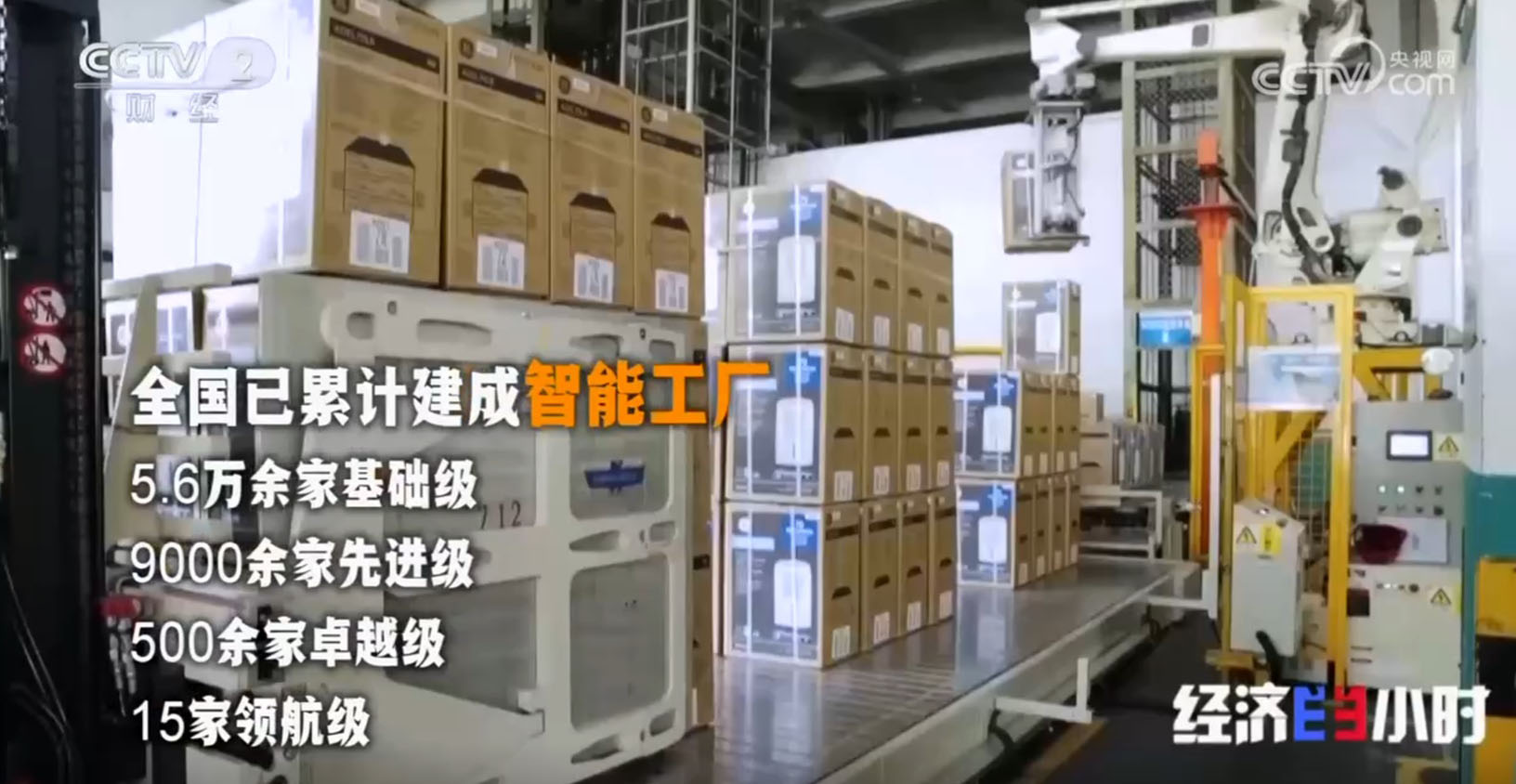
China’s Ministry of Industry and Information Technology, together with five other government departments, has officially launched the 2026 Smart Factory Graded Cultivation Initiative. The country has now established a four‑tier smart factory system:
| Tier | Number of Factories | Strategic Focus |
|---|---|---|
| Entry‑Level | 56,000 | Digital transformation |
| Advanced‑Level | 9,000+ | Digital and networked capabilities |
| Excellence‑Level | 500+ | Intelligent upgrading; national leadership |
| Pioneering‑Level | 15 | Globally leading smart manufacturing benchmarks |
Since the system was implemented, it has already delivered measurable results: product defect rates have dropped by an average of 47%, and product R&D cycles have been shortened by an average of 38%. Excellence‑level smart factories now cover all 31 provinces and more than 80% of manufacturing industry categories, with nearly 2,000 outstanding intelligent application scenarios under construction.
The AI Brain Behind a Rolling Mill
Nanjing Iron & Steel is one of the 15 pioneering‑level smart factories. In its metallography lab, quality inspector Yong Taiping now only needs to press a single button to start the process. Two robotic “apprentices” automatically handle sample preparation, microscopic imaging, and intelligent quality grading. The entire process takes less than 20 minutes for six steel samples, boosting efficiency by 80%.
Even more critical is the improvement in accuracy. The system integrates data from over 100,000 historical sample images, raising the accuracy of microstructure recognition to above 92% — behind which lies the accumulated expertise of dozens of veteran technical specialists.
On the heavy plate production line, an AI‑driven rolling force prediction model is solving a long‑standing industry challenge: when steel plates are rolled, the rolling mill frame undergoes elastic deformation. Every 10,000 kilonewtons of force causes deformation of nearly one millimeter. Traditional methods relying on empirical formulas made it difficult to control tolerances. By learning from historical rolling data for over 100,000 plates, the AI model has now brought thickness tolerance down to within ±0.2 millimeters. This single improvement has generated annual cost savings and efficiency gains of approximately RMB 4 million.
From Steelworker to AI Engineer
Perhaps the most profound change is happening in the people themselves.
Xu Xiaochun, Executive Vice President of Nanjing Iron & Steel, recalls that when he first entered the industry more than 20 years ago, “dirty, exhausting, and dangerous” was the norm. “That was the typical steelworker image — wearing a duckbill cap and goggles, holding a steel rod.” Today, the goggles and rod have been replaced by screens and a mouse. Workers now control the entire steelmaking process remotely.
“Years ago, we would have been satisfied just moving from manual to automated operations. But now it's not just automation — we're talking about informatization, digitalization, and intelligence. The journey has been remarkably fast, really just two or three decades,” Xu says.
Nanjing Iron & Steel has invested over RMB 5 billion in digital and intelligent transformation. Supply chain costs have fallen by 9%, and internal quality costs have dropped by 56%. In 2025, profit grew by 26.8%.
The next step: evolving large language models into autonomous agents — capable of self‑perception, self‑learning, self‑adaptation, self‑decision, and self‑evolution. The future of industrial manufacturing will see multiple intelligent agents collaborating and creating value together.
What This Means for Global Business
From new energy vehicles and industrial robots to 3D‑printed equipment, Chinese manufacturing is moving beyond simple scale expansion into a phase of quality transformation. The Ministry of Industry and Information Technology has made it clear that it will continue supporting the development of pioneering factories and “super‑scenario” applications in key sectors such as rail transit equipment, high‑tech vessels, new energy vehicles, and aerospace.
For multinational corporations, investors, and business delegations, walking through these smart factories is no longer just a routine site visit — it is the most direct way to understand the velocity of China’s innovation, the resilience of its supply chains, and the direction of its industrial upgrading.
From shop floors to industrial ecosystems, artificial intelligence is no longer just a technology — it has become one of the most vibrant new forces driving China’s economy.

💡 As a professional agency specializing in business study missions, corporate events, and industry access in China, we continuously track every leap in the country’s smart manufacturing evolution. We help global organizations design and deliver in‑depth site visits to pioneering‑level and excellence‑level smart factories — from itinerary planning and corporate introductions to on‑site interpretation and industry analysis. End‑to‑end, on the ground in China.
If you‘re looking to take your team inside China’s most advanced manufacturing facilities, we‘d love to hear from you.